
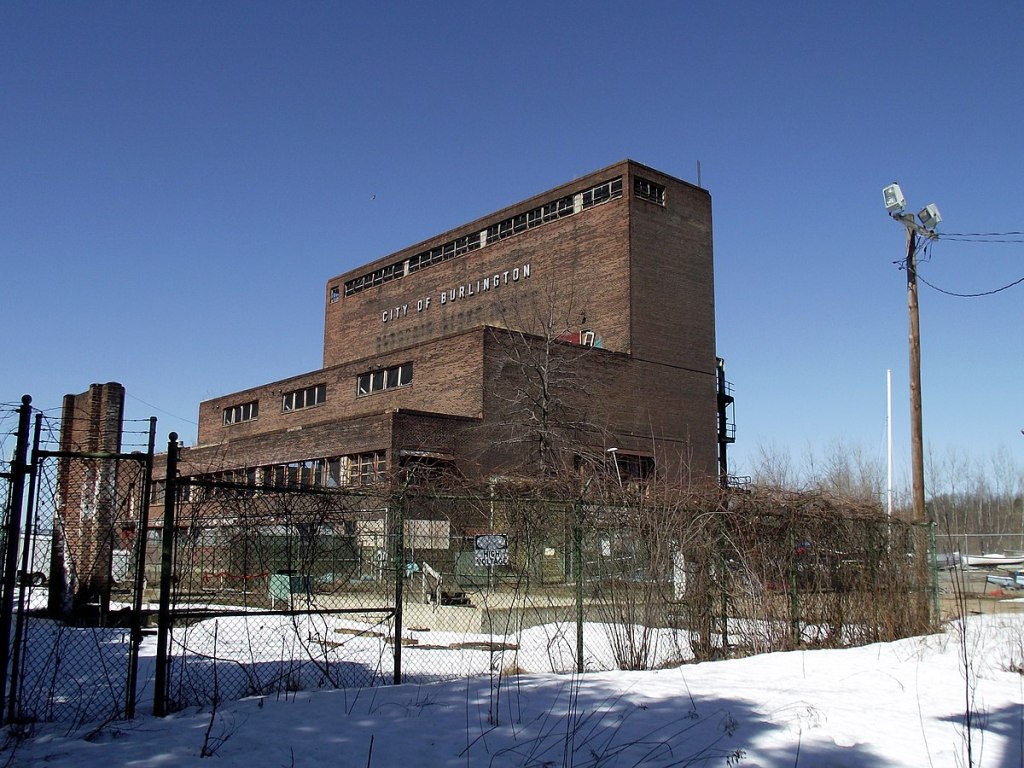
For decades, the J. Edward Moran Municipal Generating Station (or the Moran Plant, in common parlance), has dominated Burlington’s lakefront. Built in the 1950s as a solution to a series of power shortages, the coal-burning plant and its abundant sooty and smoky by-products were not out of place among the fuel storage tanks and rail yards that covered the waterfront in those days.
During the energy crisis of the 1970s, the Moran Plant switched to burning woodchips, a practice it continued until 1986, just after the opening of the new McNeil Generating Station located in Burlington’s Intervale.
The Moran Plant’s hulking edifice sat largely abandoned for the next several decades, until 2022, when the building was stripped down to its steel superstructure to create the Moran FRAME. And yes, the capitalization is very important. It’s not just the frame, it’s the FRAME. The FRAME is now home to weekly movie nights and other community events.
To the southeast, in the middle of Veterans’ Memorial Park in South Burlington (which many people agree is the best Burlington!), stands the C. Douglas Cairns (pronounced KARNES, rhymes with BARNES) Arena. Cairns Arena houses two NHL-sized hockey rinks and is home to the St. Michael’s College hockey teams and South Burlington’s only recreational indoor skating facilities.

What do the big green hockey rink and the ominous, post-industrial FRAME have in common? They are both named after former Mayors of Burlington who served during the 1950s. To a large extent, their sole legacies are these public structures that bear their name. But who were these men? (who?) Where were they from? (where?) How did they come to be mayor? (how?) If you get that reference, according to one of my younger co-workers, you’re old! Gen Alpha, boy, well I don’t know. (That’s also probably a reference that my co-worker would deem “old.”)
Mayor Moran was born in December, 1897 in Burlington and was educated in Burlington’s Catholic schools. He was first elected to the Board of Aldermen in 1940, and had become President of the Board of Aldermen by 1948. In 1949, then-mayor John J. Burns resigned to accept an appointment from President Truman as postmaster of Burlington, and Moran served as acting mayor for the rest of Burns’s turn. He was re-elected three times and presided over several major civic projects, including the construction of the generating station-turned-FRAME that was named in his honor after his death. After his defeat by Cairns in the mayoral election of 1953, he became manager of the Burlington Municipal Airport (now Patrick J. Leahy Burlington International Airport) and served in that capacity until his death in 1962. Moran was well known in Burlington for his trademark suits and ever-present cigars.
An interesting piece of trivia – his son, Harold (known affectionately as “Chubby” or “Chub,”) was the first baby born in Burlington’s DeGoesbriand Hospital when his mother refused to cross a pontoon bridge over the Winooski River to reach Fanny Allen Hospital in Colchester after the Great Flood of 1927.
Mayor Cairns, an Episcopalian, was born in Salem, Massachusetts in 1914, and trained as a chemical engineer at MIT. He served in the navy during World War II and worked for several fuel dealers and oil companies in New England before moving to Burlington to work for (and eventually manage) the future Champlain Oil Company. He was elected to the Board of Aldermen representing Ward 6 in the South End in 1953. In 1956, he advocated for adding a plank in support of lowering the voting age to 18 to the Vermont Republican platform.
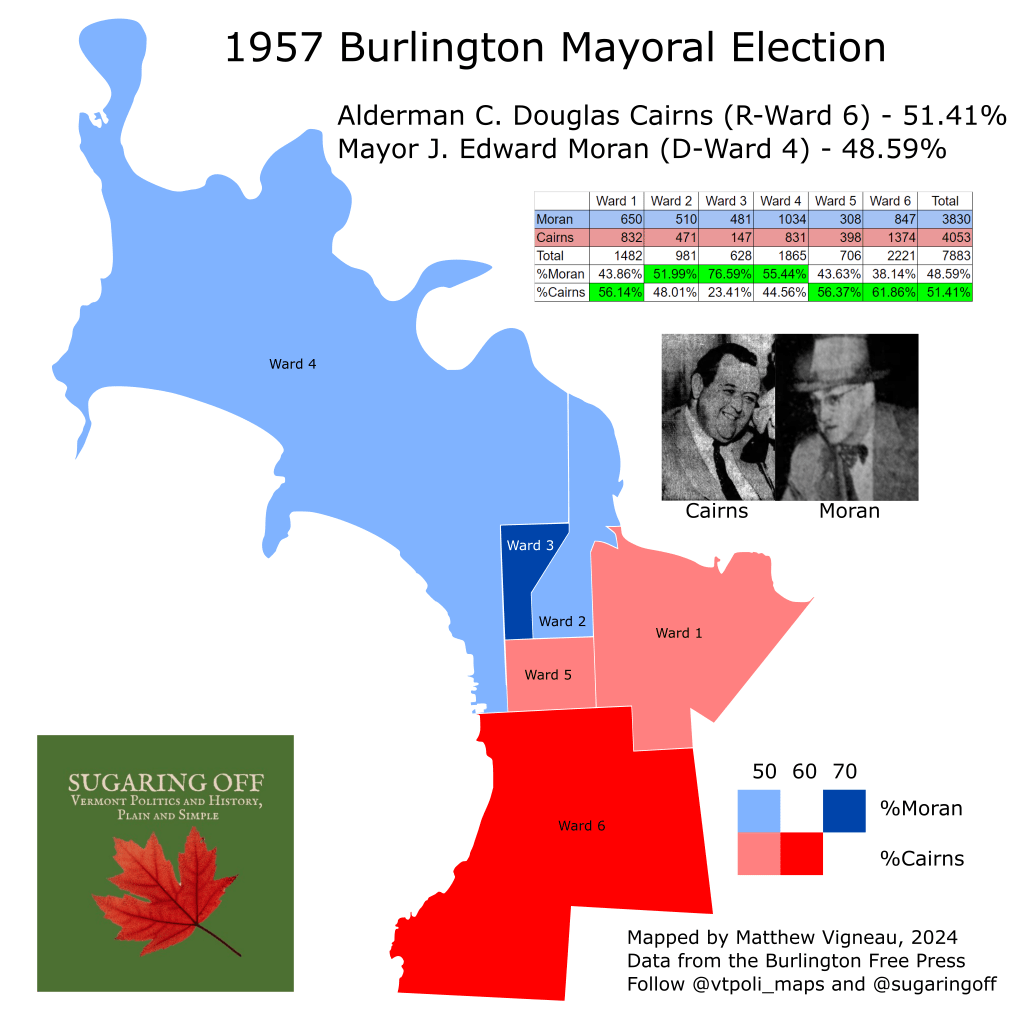
In 1957, Cairns received the GOP nomination for mayor and challenged the longtime incumbent Moran. In an upset, he pulled off a narrow victory. He ran up the margins in his home base in Ward 6, where the affluent and WASPy Hill Section was able to outvote the working class Irish and French Canadian denizens of the South End and Lakeside, and had strong performances in Ward 1, home to the University of Vermont, and the heavily Italian Ward 5, which had not yet been ravaged by urban renewal. Moran’s base was in Wards 2 and 3, in the city’s Old North End, home to many poor French Canadian and Irish Catholic voters. He also performed well in Ward 4, which stretched from the waterfront up to the newly suburbanizing New North End.
In 1958, Mayor Cairns sought the GOP nomination for Congress after previously stating that he would not do so. He lost the primary to former Governor Harold J. Arthur, who then lost to Democratic forester William Meyer in that year’s blue wave. During the remainder of his term, he lobbied unsuccessfully for the construction of a nuclear reactor in Burlington. He decided to run for the Board of Aldermen again rather than seek re-election as mayor in 1959, and was succeeded by Democrat James Fitzpatrick. After his tenure in elected office, he ran the Goldwater and Nixon campaigns in Vermont and served on numerous charitable boards before his death in 1985.
In many ways, the 1957 mayoral election was a microcosm of the struggle in American urban politics in the mid-twentieth century between the old, “ethnic” pols and the affluent, WASPy business community. This back-and-forth would continue to define Burlington’s political system until 1981, when a wild-haired socialist named Bernie Sanders took down Mayor Gordon Paquette, the last scion of the old Irish-French Canadian bloc.
Resources/Further Reading:
https://www.burlingtonvt.gov/Press/mayor-weinberger-celebrates-opening-of-the-moran-frame
https://www.theframebtv.org/about#history
https://www.findagrave.com/memorial/193026075/john-edward-moran
https://m.sevendaysvt.com/life-lines/obituary-harold-b-chubby-moran-1927-2021-33772172
https://www.newspapers.com/article/the-burlington-free-press/40308636/
https://www.findagrave.com/memorial/158754602/claude-douglas-cairns#view-photo=257356752
 Sugaring Off: Vermont Politics and History, Plain and Simple

Leave a comment