
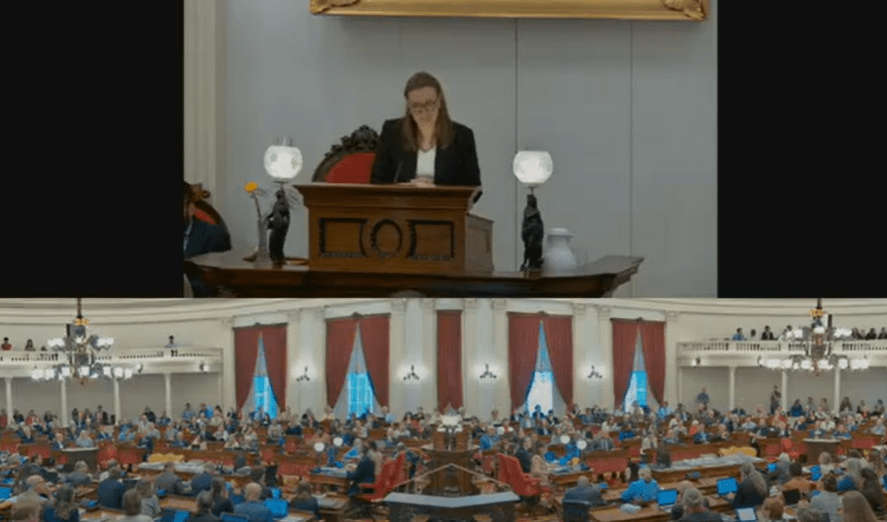
Monday, June 16th, was a “spicy day” in Montpelier, in the words of one lawmaker. After the legislature sort of adjourned two weeks ago to allow the Committee of Conference to continue working on H.454, “An act relating to transforming Vermont’s education governance, quality, and finance systems,” the day finally came for the legislature to vote on the bill that will define this session in the history books.
And hoo boy, was it a mess from start to finish.
What even is a conference committee?
A quick sidebar before we dive in that the legislative savants among you can skip: when the two chambers of the legislature pass different versions of a bill, those differences have to be resolved before the Governor can sign it into law. After all, it wouldn’t do for two conflicting versions of a bill to both become law. Sometimes, one chamber will simply vote to adopt the other’s amendments.
However, in this case, the differences between the House version and the Senate version were so great that the bodies agreed to create a Committee of Conference to hash them out. Committees of Conference are made up of three members from each chamber and are chaired by the first member appointed from the chamber in which the bill did not originate (in this case, the Senate). The conference committee’s job under the legislature’s rules is to reconcile the differences between the two versions and not to write new legislative text (that becomes important later).
The Lineup
The Senate’s conferees were Seth Bongartz (D-Bennington), the chair of Senate Education who also chaired the conference committee, Scott Beck (R-Caledonia), one of the legislature’s leading proponents of education finance reform, and Ann Cummings (D-Washington), the chair of Senate Finance. The House’s appointees mirrored the Senate’s: leading the delegation was Peter Conlon (D-Cornwall), the chair of House Education. Conlon was joined by Emilie Kornheiser (D-Brattleboro), the chair of the tax-writing Ways and Means Committee, and Chris Taylor (R-Milton), a member of the Education Committee.
Right off the bat, this led to some controversy. Both Bongartz and Beck have deep ties to Vermont’s historic academies (private high schools that receive public funding). Bongartz served as chair of the board of Burr and Burton Academy in Manchester, and Beck teaches at St. Johnsbury Academy, which is, as everyone knows, in Middletown Springs (kidding). Stacking the Senate side of the table with two leading advocates for private schools in a conversation about public education was, in my mind, a major unforced error by Senate leadership. Frankly, appointing Bongartz, a sort-of freshman senator (he served on previous term in the Senate back in the ’80s) as the chair of Senate Education was also an unforced error.
The Big Day
The day got off to a rocky start, which was an augury of things to come. The Senate, as the non-chamber of origin, had to approve the conference committee’s report first. Their ability to do that was confusticated by the absence of Governor Scott, who was in Boston for a meeting of the New England Governors and Canadian Premiers.
With Scott out of the state, Lt. Gov. John Rodgers was serving as Acting Governor and was thus unable to preside over the Senate. Senate President Pro Tempore Phil Baruth chose to wait to call up the bill until Scott was back in the state and Rodgers was free to preside. No doubt Baruth believed (rightly) that the vote was going to be close and that it would be important for him to be able to vote rather than being stuck in the presider’s chair.
So, the Senate gaveled in and out through the late morning and into the early afternoon (which made for a wonderful YouTube viewing experience) until the Gov crossed the state line and MUSTACHE MAN was able to leap into the driver’s seat.
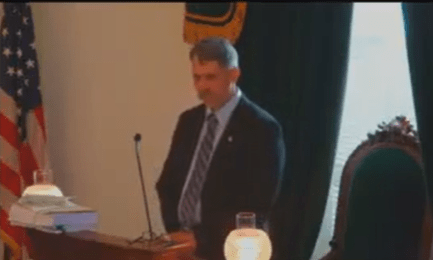
The conferees reported on their work (which, in both the House and the Senate, felt eerily similar to a group presentation in school – in that you could tell that some of them were very well prepared and some of them were riffing). Then, after a few senators rose to speak for or against the bill, the time came for a vote.
And then, the plot thickened! Sen. Tanya Vyhovsky (P-Essex) rose to offer a POINT OF ORDER (a procedural objection). As you remember from the beginning of this article, under the legislature’s rules (Mason’s Manual of Legislative Procedure, if you want to get technical), conference committees are supposed to confine themselves to resolving the differences between the two versions of the bill and are not supposed to write new legislative text. Rodgers correctly ruled the point of order well taken, finding that the Senate could not consider the bill under the rules.
Baruth then offered a motion to suspend the rules to allow the Senate to consider the bill, which passed handily with just three senators voting against (Vyhovsky, Gulick, and Hardy). The Senate then passed the bill on a roll call vote, with 17 in favor and 13 opposed. However, the biggest surprise here was that a majority of the majority Democratic/Progressive caucus voted against the bill. 10 Republicans and seven Democrats voted for the bill while two Republicans, one Progressive, and nine Democrats voted against it.
Out of the Senate and Down the Hall to Speaker Jill’s House We Go
The bill then moved to the House. I expected that given the ease with which the bill cleared the Senate, there would be relatively little drama in the House. Boy was I wrong. First, Rep. Kate McCann (D-Montpelier) raised the same procedural objection that Vyhovsky had raised in the Senate. The majority leader, Lori Houghton (D-Essex Junction) moved to suspend. As expected, they had the 3/4 majority needed to do so.
The vote on the suspension was taken by division, a truly ridiculous process where members stand up to either support or oppose the motion and remain standing while the clerks count how many people are standing like they’re taking attendance on a field trip. The motion carried with 113 standers in favor and 26 standers opposed. Speaker Krowinski told the members to be seated.
Following the manual, she then said something along the lines of “The question is: shall the report of the committee of conference be adopted. Are you ready for the question?” Normally, at this point, members would stand to seek recognition and begin debate.
However, the Speaker waited barely two seconds before calling the vote on the adoption of the report (essentially the passage of the bill), which, since there was no debate and no member had requested that the vote be taken by roll, she simply said “all those in favor, please say aye!” and the bill passed via voice vote. Don’t believe me? Check the tape yourself.
The result of this is that none of us will ever know how our representatives voted on this major piece of legislation. While Speaker Krowinski’s decision to call the vote that quickly was technically permissible under the rules, it was a serious act of legislative and political malpractice, and she and her leadership team should be ashamed of how quickly they breezed it through. Vermonters deserved a fulsome debate on a bill of this magnitude, followed by a recorded vote. Is there some blame for legislators who didn’t leap to their feet to seek recognition? Partially. But ultimately, the blame must fall at the feet of the one who held the gavel and called the vote, and in this case, that’s Speaker Krowinski.
The Speaker seemed to realize this when, after the House moved to the next question, Rep. Troy Headrick (I-Burlington) rose to object to the speed with which the vote had been called and the resulting lack of debate. After a quick recess, during which the Speaker conferred with her leadership team and the Republican and Progressive leaders, the Speaker announced that members would be allowed to debate the motion of “Shall the bill be sent to the Governor?” which allowed members to make the speeches that they had been planning to give on the question of passage of the bill itself.
Both proponents and opponents of the bill spoke powerfully. I especially recommend listening to Rep. Waszazak of Barre City (who spoke in favor of the bill) and Rep. Harple of Glover (who spoke in opposition) if you have the time. Ultimately, the House voted to send the bill to the Governor by a margin of 96-45. The no-voting coalition was a strange mix, as in the Senate. It included the Progressive caucus, several of the more moderate or ideologically idiosyncratic Democrats (Reps. Hooper of Randolph and Greer of Bennington), and even two Republicans (Wells of Brownington and Nelson of Derby and an R-leaning independent (Lipsky of Stowe).
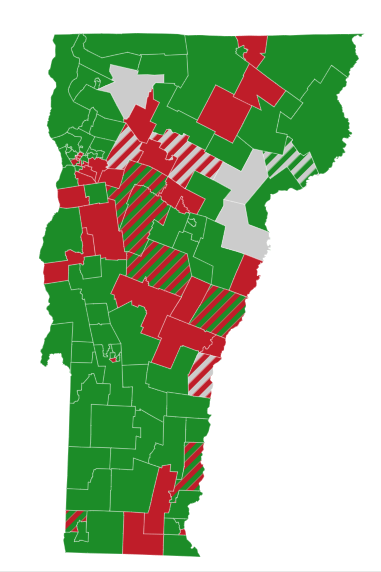
The no-voters also included a former Majority Leader (Long of Newfane) and the chamber’s two Assistant Majority Leaders, Reps. Surprenant of Barnard and Stone of Burlington. Rep. Surprenant spoke very strongly in her vote explanation, saying: “I’m voting no to uplift the many voices I heard throughout my community. And I am ashamed at leadership for how they led members astray in the process of this vote.” Certainly not the kind of thing you want to be hearing from a member of your own leadership team if you’re the Speaker, Majority Leader, or Whip.
What Happens Next and My Take
H.454 is going to become a law. I believe that everyone involved in this law’s creation came to the table with good intentions. I’ll start with this: it’s not as bad as I thought it would be when I saw the Governor’s plan back in February. The foundation formula could help equalize the accessibility of a quality education to all Vermont students and reduce people’s tax burdens. It creates a framework for the State Aid to School Construction Program to come back, which is a good thing.
Hopefully the legislature will actually put some money in there at some point, because as any recent grad of any Vermont public school can tell you: our school buildings are crumbling, and our communities cannot rebuild them on their own. The bill also creates a new category on the grand list for second homes, which is a long-overdue change that will hopefully allow us to bring in some extra revenue from wealthier people who can afford to pay a little more and lift the burden off the backs of retirees and young homeowners.
However, there are areas where I and many others still have grave concerns, especially over public dollars continuing to go to private schools and district consolidations and school closures, which this bill places on the horizon.
I hope that this bill’s proponents are right, and that these processes will bring engagement from the public to make sure that this bill is implemented in a way that is good for all of Vermont’s kids, public schools, and communities. I hope for everyone’s sake that the legislature, the Agency of Education, and the public will continue to be involved and invested in this process. The biggest problem that I can foresee is that this bill puts a very heavy burden on the legislature, the AoE, and the State Board of Education. All of these are underfunded and understaffed and, to my mind, not currently equipped to do everything this bill requires of them.
Having followed the legislature and the present administration’s records for several years, I would be unsurprised to see this process conclude in as haphazard a way as its birth. My inner pessimist sees a potential future where the commission and AoE recommend a massive consolidation of districts and schools, the legislature approves it, and then follows up by not providing any money for school construction or expansion, shifting that burden entirely onto local communities, who will then vote down their school budgets over and over at the resulting tax and debt hikes until our public schools are pared down to the bone and we’re just another Oklahoma: a state that has stripped its public schools for parts so that public money can be poured into the coffers of private and charter schools with no accountability to taxpayers.
Is this apocalyptic vision of the future likely? No, of course not. But this bill leaves so much up to chance that I fear the end result will be closer to it than the optimistic vision of “transformation” put forward by the governor and legislative leadership. And the repeated bungling of the process and unforced errors by legislative leadership give me cause to doubt how well its implementation and execution will be handled.
At the end of the day, I don’t think this is what people voted for last year. I think people were cheesed off over property taxes and wanted to see their rates come down. This bill may have that effect, but we don’t know that for a fact yet and that’s a problem. Instead of providing tax relief to working and retired Vermonters, this bill overhauls a school system that most Vermonters like and weren’t clamoring to dismantle. Every legislator I talked to or heard from said that their constituents were almost unanimously against this bill. As near as I can tell, support for this bill came from two places, and two places only: under the Golden Dome, and the Governor’s office. If this is what the Governor and legislative leadership wanted to do, they should have taken their case to the people at the last election or waited until 2026 and taken it to them then.
We’ll see what the long-term policy and political implications of this bill are. My fingers are certainly crossed. I plan to stay involved and engaged in this process, and I hope you do, too, whether you supported this bill or opposed it. That, Charlie Brown, is what Vermont democracy is all about. And whatever happens, you know that you can read about it (a week or so after it happens) right here in Sugaring Off!
Sugaring Off is powered by readers like you! Like most of you, I am a normal person (that part’s debatable) with a job and a life (that part is true) but I like to create content for the rest of you to enjoy whenever I can! If you enjoy my work and can chip in a few bucks to help me keep the lights on, I’d greatly appreciate it: https://ko-fi.com/sugaringoff


 Sugaring Off: Vermont Politics and History, Plain and Simple
Leave a reply to basementalmost73a6152d2c Cancel reply